How we review
A Mintcanopy review opens an account, finds the fee screen, tries the export, and writes down who should not buy. The score is the average of those checks, and a missing check stays missing instead of being smoothed into a kinder number.
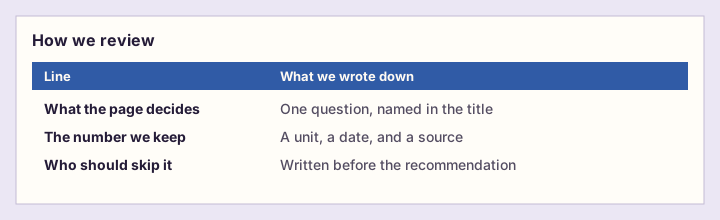
The four checks
First, the price has a unit: percent of assets, dollars a month, or percent of a fill, and the unit is written on the review. Second, we open the screen where that price is shown and we draw it with the navigation still visible, so you can see it was a product and not a slogan. Third, we try to export the work. Fourth, we name the reader who should skip the product. The score is those four. A product does not get a 5 for a charming demo.
A missing check
If the export fails, the review says it failed and the score drops. We do not substitute a vendor's promise that an export is coming next quarter. If we cannot open an account without a sales call, the review says we could not open an account, and we do not invent a table. Mintcanopy will leave a category short rather than fill it with a product we only saw on a slide.
Money
Affiliate commissions are disclosed and are not an input to the score. We do not accept a free year of a product in exchange for a review. We do use free trials and the cheapest public plan, and we say which one we used. The method is the same on a $29 charting tool and on a 0.25 percent adviser. Only the bill changes.
The same four checks at two prices
A $29 chart and a 0.25 percent adviser get the same method. Unit, screen, export, skip. We use the public plan or the free trial and we say which. We do not take a free year in exchange for coverage. A missing export is written as missing. A sales-call-only product is written as unopened. The category stays short rather than fill with a slide.
Commissions are disclosed and are not in the average. The score is the checks. Charm is not a check.
A score sheet, filled twice
Harbor Path, the passing sheet. Price unit: 0.25 percent of assets a year, on the screen, before a bank link. One point. Screen drawn with Fees selected in the navigation and the three account rows visible. One point. Export: tax-lot CSV, date, shares, cost, matched to the $80,000 taxable row. One point. Skip: concentrated employer stock, named. One point. Missing: we have not watched a live debit for a year. Half a point off. The 4.6 is that sheet, not a feeling about the logo.
A product we did not publish, so it has no name here. The demo was a slide. The fee "depended." The export was "on the roadmap." We could not draw a screen we had not opened. The sheet stayed blank and the product stayed out of the catalog. Mintcanopy would rather a short category than a fifth name that only exists on a slide. The same sheet is used on a $29 chart and on an adviser. Charm is not a row on it.
A half point, named
Harbor Path lost half a point because nobody has watched the fee leave a funded account in cash. That half point is not a vibe. It is a missing row on the sheet. A product that loses a full point for a missing export does not get the half point back for a polite salesperson. A product that loses the skip point, because the skip said "may not suit everyone," is unpublished until the skip names a person. Mintcanopy would rather show the sheet than a medal. The method page is the sheet. The review is the sheet filled in for one product.
Free trials and the cheapest public plan are allowed. A free year offered in exchange for coverage is not. We say which access we used. If the only access was a slide, the sheet stays blank. The same rows are used on Chartloom at $29 and on an adviser at 0.25 percent. The bill changes. The rows do not.
The sheet, row by row
Row one is the unit, written as the vendor wrote it and then in dollars or in a month of fills. Row two is the screen: we opened it, and the drawing on the review shows the navigation item that was selected. Row three is the export, opened in a spreadsheet, or a sentence that says it failed. Row four is the skip, a person with a situation, not a cautious investor. Harbor Path fills all four and loses half a point on a fifth row we will not pretend we observed: a year of cash debits. A slide-only product fills none and is not published. Mintcanopy uses the same rows on every review. A free year offered for coverage is refused. A free trial is allowed and named.
The row we leave blank
On Harbor Path the blank row is the year of cash debits we have not watched. The other rows are filled: 0.25 percent, the Fees item in the navigation, the lot CSV matched to $80,000, and the employer-stock skip. A product reviewed from a slide has every row blank and does not get a number. Mintcanopy would rather publish the blank than smooth it into a 5. The same sheet is used when the price is $29 a month. Access that counts is a trial or the public plan, named in the review. A free year traded for a score does not count.