Editorial policy
A review on Mintcanopy is published when the fee, the export, and the reason to skip the product are all on the page. A vendor does not read the draft for approval, and a correction is dated on the page rather than quietly overwritten.
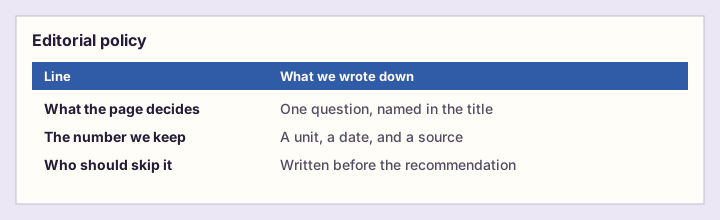
What has to be on the page
A review is not published until the price is specific, the export has been tried or the failure has been written down, and the skip paragraph names a real reader who should walk away. A category page is not published as a ranking a vendor can buy. A guide is one decision. Those are the gates. A draft that has a mood but not a fee stays a draft.
Corrections and takedowns
If a fee changes, the page changes and the date of the change is visible. If we were wrong about an export, the sentence is replaced and the old claim does not linger in the summary. We do not unpublish a negative finding because the vendor objected. We do unpublish a finding we cannot repeat. Mintcanopy would rather have a shorter page than a page that survived on a single demo we cannot rerun.
Who does not get a veto
The vendor does not approve the wording. An affiliate manager does not approve the score. An advertiser, if one ever appears, does not get the paragraph beside the review. At the time of writing the pages carry no display ads. If that changes, the ad has to be labeled and it cannot sit inside the fee table.
The gates
No price, no publication. No export attempt, no publication. No named skip, no publication. A vendor does not clear the wording. A paid link does not clear the score. A correction is dated. A finding we cannot repeat comes down. A finding a vendor dislikes stays up. There are no display ads in the fee table. If an ad ever appears, it is labeled and it sits outside the review.
A draft with a mood and no fee remains a draft. That rule is the whole policy.
A finding that came down
An early note claimed a bot export included the exchange fee because a salesperson said it did. We could not open the CSV a second time. The sentence came down the same day, and the review was not published until the row was either in a file we could reopen or described as missing. Mintcanopy would rather a shorter catalog than a sentence that survived on one demo. A vendor who dislikes a finding that we can repeat does not get the same treatment. The skip paragraphs stay.
Gates, restated as a checklist a new writer can hold: a price with a unit, an export attempted or a failure written, a skip that names a person, no vendor approval of the draft, no paid link inside the score, a date on a correction. A draft with a mood and no fee remains a draft. Display ads are not in the fee table. If an ad ever appears, it is labeled and it sits outside the review.
Who reads a draft
A second person on the desk reads the draft for the unit, the export, and the skip. The vendor does not. An affiliate manager does not. If the second person cannot find the fee, the draft goes back. If the second person can find only a mood, the draft goes back. Mintcanopy does not keep a committee large enough to blur that. A correction after publication is dated on the page. A finding we cannot repeat comes down the day we discover we cannot repeat it, as the bot-export sentence did. A finding a vendor dislikes, and that we can open again, stays.
The day a sentence came down
A salesperson said a bot's CSV included the exchange fee. We could not reopen the file. The sentence came down the same day, and the review waited until the cell was either in a file or described as blank. That is the standard. A vendor who dislikes Harbor Path's employer-stock skip does not get the same day, because we can open that limitation again. Mintcanopy dates corrections. A second reader on the desk checks the unit, the export, and the skip before publication. The vendor is not that reader. A mood with no fee stays a draft.
Repeatable, or it comes down
The bot CSV that a salesperson described, and that we could not reopen, came down the same day. Harbor Path's skip stays, because we can open the limitation again: one employer stock, blackout dates, no plan. Mintcanopy dates the difference. A second person checks unit, export, and skip. The vendor is not that person. Display ads do not sit in the fee table. A draft with a mood and no price is still a draft.
Who is not in the editing chair
The vendor is not. The affiliate manager is not. An advertiser is not, and at present there is no display ad inside a fee table to negotiate. The second person on the desk is in the chair, and they send the draft back if the unit is missing, if the export was not tried, or if the skip says only that cautious people should be careful. Mintcanopy took down the bot sentence we could not reopen and left Harbor Path's employer-stock paragraph up. Those are the two directions a published line can move. Embarrassment is not a direction. A date stays next to the change so a reader can see the page is a record.