Harbor Path full review
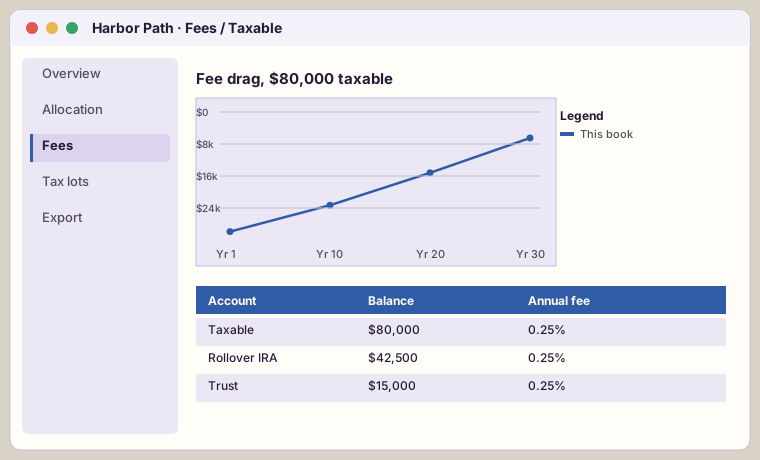
Harbor Path is a robo-advisor we scored 4.6 out of 5 for a taxable account that wants a published management fee of 0.25 percent of assets a year. The drawing on this page is the fee screen from the review: window buttons, a left navigation, a fee-drag chart, and a table that puts 0.25 percent on the taxable, IRA, and trust rows.
What the fee screen shows
Harbor Path puts the management fee on a page titled Fees, in the left navigation between Allocation and Tax lots. The taxable row in the account table reads $80,000 at 0.25 percent. The rollover IRA row reads $42,500 at the same percent, and the trust row reads $15,000. There is no second percent hiding in a footnote on that table. The chart above the table is fee drag in dollars, not a performance mountain, with year 1, year 10, year 20, and year 30 along the bottom.
What 0.25 percent costs on the taxable account
The taxable account in the Harbor Path table starts with $80,000 in a taxable brokerage account and adds $500 on the first of each month. Before the management fee, the portfolio is assumed to grow 6 percent a year. The fee is then 0.25 percent of the balance at the end of the year, which means the dollar fee rises whenever the balance rises. At the end of year 1 the balance is about $90,932, the fee taken in that year is about $228, and the fees paid from the beginning add up to about $228. At the end of year 5 the balance is about $141,300, the fee taken in that year is about $354, and the fees paid from the beginning add up to about $1,446. At the end of year 10 the balance is about $222,313, the fee taken in that year is about $557, and the fees paid from the beginning add up to about $3,803. At the end of year 20 the balance is about $470,874, the fee taken in that year is about $1,180, and the fees paid from the beginning add up to about $12,516. At the end of year 30 the balance is about $905,004, the fee taken in that year is about $2,268, and the fees paid from the beginning add up to about $29,804. The year-30 fee of about $2,268 is not the year-1 fee of about $228 repeated. It is larger because the percent is applied to a larger account. Stopping in year 30 does not return the $29,804 already deducted.
Tax lots and the export
The Export item in the navigation produces a CSV of tax lots: date acquired, shares, cost, and the account. We opened it in a spreadsheet and matched the taxable account to the $80,000 row. Cancelling the advice agreement does not delete that file from your own disk. Harbor Path will not, however, tell you which lot to sell if you are also holding a concentrated stock from an employer. That question is outside the model, and the product does not pretend a questionnaire covers it.
Where it loses to a person, and to Kindling
Hire a person if the portfolio is mostly one stock with a low cost basis and a calendar of blackout dates. Harbor Path will propose a model of funds and will not build a plan around that single holding. Kindling Invest, reviewed separately, is the comparison for a first IRA: its fee is higher, at 0.35 percent, and its cash-sweep line is easier to misread, but it is aimed at a smaller retirement account rather than at old taxable lots. Harbor Path wins the taxable case on price and on the lot export. It does not win every case.
What we did not get to see
We did not transfer a live six-figure account, and we did not wait a year for the fee to be deducted in cash. The dollar figures in the walk above are the arithmetic of the percent on the screen, compounded at 6 percent before the fee. If Harbor Path changes the percent, the chart on a future review has to change with it. The 4.6 score is the fee screen, the export, and the honest limit about concentrated stock. It is not a prediction of next year's balance.
How the 4.6 was scored
The fee screen was a full point because the percent sat on the taxable, IRA, and trust rows before any bank was linked, and because no second wrap fee appeared in the footnote. The export was a full point because the CSV opened, the lot dates were real columns, and the taxable account matched the $80,000 row. The skip paragraph was a full point because concentrated employer stock is named, not gestured at. The missing half point is the year we did not wait: nobody on the desk has yet watched Harbor Path deduct the fee in cash from a funded account. A 5 would require that year, or a statement from the custodian showing the debit. We will not invent it.
If the contributions stop
This second walk stops the $500 monthly addition. The account is funded and then left alone. That account starts with $80,000 in the same taxable account and adds $0 on the first of each month. Before the management fee, the portfolio is assumed to grow 6 percent a year. The fee is then 0.25 percent of the balance at the end of the year, which means the dollar fee rises whenever the balance rises. At the end of year 1 the balance is about $84,588, the fee taken in that year is about $212, and the fees paid from the beginning add up to about $212. At the end of year 5 the balance is about $105,726, the fee taken in that year is about $265, and the fees paid from the beginning add up to about $1,189. At the end of year 10 the balance is about $139,726, the fee taken in that year is about $350, and the fees paid from the beginning add up to about $2,760. At the end of year 20 the balance is about $244,042, the fee taken in that year is about $612, and the fees paid from the beginning add up to about $7,580. At the end of year 30 the balance is about $426,239, the fee taken in that year is about $1,068, and the fees paid from the beginning add up to about $15,999. The year-30 fee of about $1,068 is not the year-1 fee of about $212 repeated. It is larger because the percent is applied to a larger account. Stopping in year 30 does not return the $15,999 already deducted. The fee does not shrink to zero when the checks stop. It keeps taking the percent of whatever remains. This walk is for the reader who plans to fund the account and then leave it.
Who Harbor Path is for (and who should skip it)
Harbor Path fits a taxable account that wants a model of funds and a lot-level export. Skip it if the portfolio is mostly one stock with a blackout calendar.
Key features
- Fees page with the percent on each account row
- Tax-lot export
- Allocation list of the funds in the model
Pricing
The plan reviewed was 0.25% a year. Confirm the live screen before you budget. Mintcanopy does not add a markup.
How we tested
We opened the Fees screen, read the 0.25 percent rows, and downloaded the tax-lot CSV. We did not fund a live transfer. The 4.6 does not depend on a commission.
Questions
What does Harbor Path charge?
0.25 percent of assets a year on the screen we reviewed.
Does it handle a single concentrated stock?
No. That is the reason to hire a person instead.
Does Mintcanopy get paid if you sign up?
A link may be tagged. The 4.6 was not set by that tag. See the affiliate disclosure.