Variance notes a controller can read
A variance note a controller can read says the line, the dollar gap, and the reason, in that order. This guide uses contractors $6,400 over budget, software $800 under, and travel $2,200 over, and refuses a note that only says "timing."
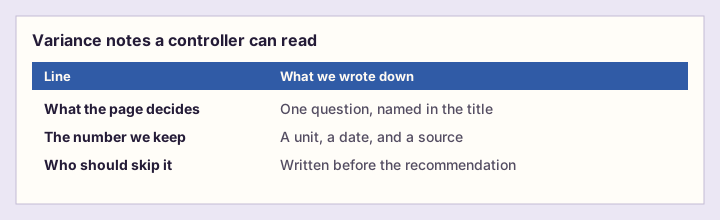
Three lines, three reasons
Contractors, $48,200 actual, $6,400 over, because two invoices landed in one month. Software, $11,900, $800 under, because the annual renewal is next quarter and this month is only the monthly tools. Travel, $4,100, $2,200 over, because a conference moved forward. A controller can argue with each sentence. A controller cannot argue with "timing" written three times.
The export
The file a reviewer should demand is line, actual, budget, variance, and note. Ledger Mint produces that CSV and, in our test, still allowed an empty note. That gap is on the review. This guide's standard is stricter than the product: if the note is empty, the line is not finished. Do not accept a chart of variances with no sentences. The chart is the index. The note is the page.
What this is not
It is not an audit of whether the contractor should have been hired. It is the sentence that lets a second person find the invoice. If the note names the invoice and the invoice is wrong, the note did its job and the bill is a different problem. Software that writes a fluent note without a name or a number has not done the job, however complete the sentence sounds.
The sentence a controller can use
Contractors, two invoices, $6,400. Software, renewal next quarter, $800 under. Travel, conference pulled forward, $2,200. Each sentence has a document behind it. "Timing" has none. The CSV is line, actual, budget, variance, note. An empty note means the line is not finished, even if Ledger Mint currently allows the export. This guide is stricter than the product on purpose.
The note does not prove the hire was wise. It proves where to look.
The follow-up each sentence earns
Contractors, two invoices, $6,400 over. The follow-up is the invoices, the vendor name, and whether both were coded to the same department. Software, renewal next quarter, $800 under. The follow-up is the renewal date and the monthly seat list that remains. Travel, conference pulled forward, $2,200 over. The follow-up is the receipt and the month the budget had expected. "Timing" earns no follow-up, which is why it is not a note. The CSV is line, actual, budget, variance, note. Ledger Mint allows an empty note to export. This guide does not. An empty cell means the line is unfinished even if the file downloaded.
The note does not prove the contractor should have been hired. It proves where to look. If the note names the wrong invoice, the note failed and the invoices still exist to correct it. Mintcanopy will not treat a fluent sentence as a control. The controller's question is the test of the sentence.
Empty is unfinished
Ledger Mint will export a row with a blank note. This guide will not call that row finished. Contractors need the two invoices. Software needs the renewal month. Travel needs the receipt. A controller who receives "timing" three times has received an index of problems with the index entries deleted. Mintcanopy scores the product for the sentences it can hold and marks the empty export as the gap. The guide is stricter than the product on purpose. If a later version blocks the empty note, the review can move. Until then the standard on this page is the stricter one.
The question each line earns
Contractors, $6,400 over, two invoices, one vendor: ask for the invoices and the department code. Software, $800 under, renewal next quarter: ask for the renewal date and the monthly seats that remain. Travel, $2,200 over, conference pulled forward: ask for the receipt and the month the budget expected. Timing earns no question, so it is not a note. Mintcanopy still calls a row unfinished when Ledger Mint exports it with an empty note. The product allows the empty cell. This guide does not. The note does not prove the hire was wise. It proves where to look.
Bring the document, not the adverb
Two contractor invoices for the $6,400. A renewal date for the $800 software underspend. A receipt for the $2,200 travel pull-forward. Timing brings nothing, so the line is not done. Mintcanopy is stricter than Ledger Mint, which will still export a blank note. Use the guide when you decide the file is finished. Use the review when you decide whether the product enforces that. The note can name the wrong vendor. The invoice still wins.
Three documents on the desk
The contractor packet is two invoices that explain $6,400. The software packet is a renewal date that explains why this month is $800 under. The travel packet is a receipt and the original budget month for the $2,200 pull-forward. A controller who has those packets can argue. A controller who has the word timing three times cannot. Mintcanopy will mark the Ledger Mint export unfinished while a note cell is blank, even though the product currently allows the download. The sentence is a pointer to the packet. It is not a judgment that the contractor should have been hired, and a wrong vendor name means you open the packet and correct the sentence. The packet stays in the file even when the sentence is fluent.