How an affiliate review earns, and how to see it
An affiliate review earns money when a reader clicks a tagged link and later pays the vendor, and the reader should be able to see that tag. This guide follows one $49 monthly plan from the click to the cookie to the sentence on the review that has to stay true either way.
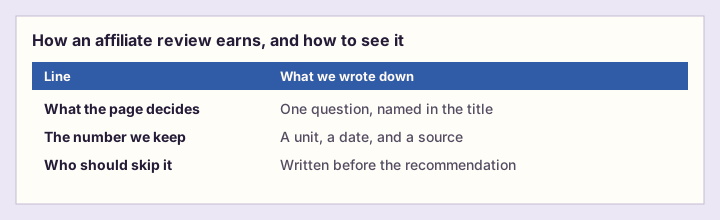
One click, one $49 plan
A reader clicks a Folio Lens link tagged for Mintcanopy and later subscribes at $49 a month. The vendor may pay the desk a percent of that subscription or a flat bounty. The review's 4.5 score was written from the filing list and the source line, and it would stay on the page if the tag were removed. The reader should be able to see that the link is tagged. Hiding the tag is the failure this guide is about.
What the tag is not allowed to change
It is not allowed to change the order of products on a category page. It is not allowed to delete a con. It is not allowed to choose the example numbers. The affiliate disclosure page says the same thing in the language of a policy. This guide says it as a path you can follow: click, cookie, payment, sentence. If you cannot find the sentence that would remain true without the payment, the review is an ad and should be labeled as one.
A page with no tag
Some products will not pay, or we will not take the link. Those reviews still get a score. A missing commission is not a reason for a lower number, and a present commission is not a reason for a higher one. When you read a review, look for the disclosure line and then look at the fee table. The table is the work. The line is how the desk keeps the lights on without pretending otherwise.
The $49 path
Click a tagged Folio Lens link. A cookie may be set by them. A $49 subscription may pay Mintcanopy later. The 4.5 stays if the tag is removed, because it came from the source line. The tag cannot reorder the category, delete a con, or pick the example. If you cannot find the sentence that survives without the payment, the page is an ad. A review with no tag is still scored. Absence of a commission is not a penalty.
Look at the fee table after you look at the disclosure. The table is the work.
From the click to the sentence
You are on the Folio Lens review. The link is tagged. You click it. A cookie may be set by the vendor, not by Mintcanopy. You subscribe at $49 a month. A report may later show a subscription and a commission, often without your name. The sentence that has to survive is the one about Item 1A and the verb "material." Remove the tag and the sentence stays. The 4.5 stays. The tag cannot reorder the category, delete the con, or pick the $214 million Harbor Glass figure. If you cannot find that surviving sentence, you are reading an ad.
A review with no tag is still scored. Absence of a commission is not a penalty. Look at the fee table after you look at the disclosure. The table is the work. The disclosure is how the desk keeps the lights on without pretending the lights are the work.
The sentence that has to survive
Remove the tag on the Folio Lens link and read the review again. The 4.5 has to still follow from Item 1A and from the verb that was stronger than the filing. The $49 price has to still be the vendor's price. The commission, $117.60 in the worked example of 20 percent of the first year, has to be obviously unnecessary to the score. If the review collapses without the tag, it is an ad. Mintcanopy labels the tag and leaves the table. Look at the table after the disclosure. A review with no tag is still scored. A missing bounty is not a penalty and a bounty is not a raise.
Read it twice
First read with the tag visible: Folio Lens, $49 a month, a cookie that may be the vendor's, a commission that in the worked example is 20 percent of $588, or $117.60, paid by them. Second read as if the tag were gone. The 4.5 has to still follow from Item 1A and from a verb that was stronger than the filing. If the second read collapses, the page is an ad. Mintcanopy does not let the tag reorder a category or delete a con. A review with no program is scored anyway. Look at the fee table after the disclosure.
The second read is the test
With the tag, a $49 plan may pay a commission, $117.60 in the 20 percent example, from the vendor's side. Without the tag, Item 1A and the stronger verb still have to justify the 4.5. If they do not, you are not reading a review. Mintcanopy will not let the cookie reorder Folio Lens above Quarry or delete a con. No program is not a penalty. The table is the work. The line about the tag is how you know the table was not for sale.
Tag on, tag off
Leave the tag on and you may set a vendor cookie and later subscribe at $49, which can pay Mintcanopy from the vendor's side, $117.60 in the worked 20 percent example. Turn the tag off in your head and read again. The review has to stand on North Mills, the item number, and the verb that got stronger than the filing. The order of the category has to stay. The con has to stay. If the second reading is empty, label the page an ad and stop. A review that never had a tag is scored with the same sheet. We do not punish a product for having no bounty, and we do not pay it a higher number for having one.