API keys for a crypto bot: the permission you should refuse
An API key for a crypto bot should be able to read balances and place trades, and it should not be able to withdraw. This guide is the permission screen Gridwell should show, and the key we would revoke if Withdraw were toggled on.
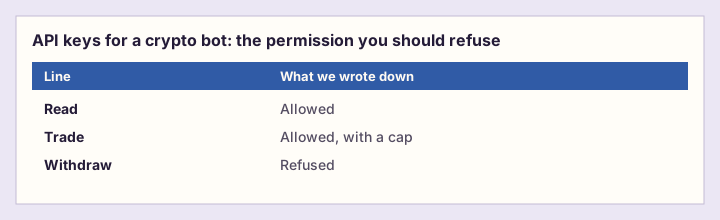
Three permissions
Read balances lets the bot see what is there. Trade lets it place and cancel orders up to a cap you set. Withdraw lets it move coins to an address that is not the exchange. The third permission is the one this guide tells you to refuse. Gridwell's review screen shows that refusal. If a setup wizard turns Withdraw on to "finish connecting," turn it off before you fund anything, and if the toggle will not stay off, do not fund it.
A key you can revoke
Create the key with a name that says which bot it is, and store the secret outside the bot's log. If the log prints the secret, that log is now the key. Revoke the key when you stop the strategy, not when you remember next quarter. The kill switch on Gridwell stops new orders. It is not the same as revoking the key. Do both. Driftlane asks for the same split, and the same answer applies.
The cap
Trade permission without a size cap is how a bug sells the whole balance. Set the cap below the amount you are willing to see gone in an hour. The cap is part of the price of the product even though it is not on the subscription invoice. This page is the permission list a future review has to photograph, in the sense of the drawing we publish: the three rows, with Withdraw marked no.
Withdraw stays off
Read, trade with a cap, and no withdraw. Name the key after the bot. Do not let the log print the secret. Revoke the key when you stop, and also hit the kill switch, because they are different. A wizard that enables withdraw to finish setup is a reason to stop the setup. The cap should be an amount you can stand to see gone in an hour, which is part of the price and not on the invoice.
Gridwell's screen is this list. If the screen changes, the review changes. The drawing on that review is not optional.
A key with a name and a cap
Create the key as gridwell-paper-march, not as "default." Read balances, allowed. Trade, allowed, cap $500 an order, which is an amount the paper account could stand to see gone in an hour. Withdraw, refused, and the refusal saved. The secret was stored outside the bot log. We checked the log after the first fill and the secret was not in it. If it had been, that log would have been the key, and the test would have stopped. Revoke the key when the strategy stops, and also hit the kill switch, because the switch does not revoke the key and the revoke does not cancel an order already working.
A wizard that enables Withdraw to finish setup is a reason to stop. Driftlane gets the same answer. The cap is part of the price of the product even though it is not on the $24 invoice. Mintcanopy draws this list on the Gridwell review because a paragraph without the three rows is easy to skim past. The drawing is the rows.
After you stop
Stopping the strategy is two actions. The kill switch cancels the intent to place new orders. Revoking the key removes the credential. Doing only the first leaves a key that can trade if a process restarts. Doing only the second can leave a working order on the exchange. Do both, and do them when you stop, not next quarter. The cap of $500 was the amount the paper test could stand to lose in an hour. Your cap should be yours, written down, and it is part of the price even though Gridwell's invoice says $24. Mintcanopy draws the three rows because a paragraph is easy to skim. Withdraw stays off.
Name, cap, refuse, then both stops
Name the key gridwell-paper-march. Allow read. Allow trade with a cap of $500, or whatever amount you can stand to see gone in an hour. Refuse Withdraw, and confirm the toggle does not save in the on position. Keep the secret out of the log. When you stop, hit the kill switch and revoke the key. The switch does not revoke. The revoke does not cancel an order already working. Mintcanopy treats a wizard that turns Withdraw on as a reason to stop the setup. The cap is part of the price even though the invoice says $24. Driftlane gets the same three rows.
Two shutdowns
The kill switch stops new orders. Revoking gridwell-paper-march removes the credential. Leave either one undone and the paper test is not actually stopped. Read and trade stay on. Withdraw stays off. The $500 cap is an example of a loss you can stand in an hour, and it is not printed on the $24 invoice. Mintcanopy uses the same refusal on Driftlane. A wizard that enables Withdraw to finish is the end of the setup, not a step in it.
The log is the key if the secret is in it
After the first paper fill, open the bot log and search for the secret you were shown once. If it is there, stop, revoke gridwell-paper-march, and treat the log as compromised. If it is not there, the rest of the test can continue: read allowed, trade allowed under the $500 cap, Withdraw refused and unable to save as on. Mintcanopy counts the kill switch and the revoke as two later steps, not as synonyms. Driftlane is held to the same log check. The invoice can say $24 and still omit the cap, which is part of the price because it is the amount a bug is allowed to lose before a person notices.