What a robo-advisor fee costs over 30 years
A robo-advisor fee of 0.25 percent a year is not 0.25 percent of the first check you send. On an $80,000 taxable account that also receives $500 a month, the fee is taken from the whole balance every year for thirty years, and the dollar amount grows because the balance grows.
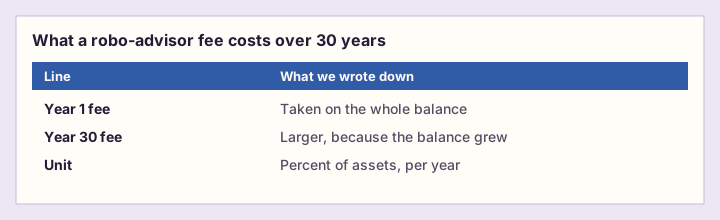
The unit is the whole balance, every year
Advisers, human and software, quote a percent because a percent looks small beside a one-percent traditional fee. The dollar bill is the percent times the account you have at the time, not times the deposit you made on day one. A slide that shows a rising balance and a single "0.25%" in the corner has not shown the bill. This guide multiplies it.
Thirty years on an $80,000 taxable account
This example, the one drawn in the Harbor Path review, starts with $80,000 in the taxable account and adds $500 on the first of each month. Before the management fee, the portfolio is assumed to grow 6 percent a year. The fee is then 0.25 percent of the balance at the end of the year, which means the dollar fee rises whenever the balance rises. At the end of year 1 the balance is about $90,932, the fee taken in that year is about $228, and the fees paid from the beginning add up to about $228. At the end of year 5 the balance is about $141,300, the fee taken in that year is about $354, and the fees paid from the beginning add up to about $1,446. At the end of year 10 the balance is about $222,313, the fee taken in that year is about $557, and the fees paid from the beginning add up to about $3,803. At the end of year 20 the balance is about $470,874, the fee taken in that year is about $1,180, and the fees paid from the beginning add up to about $12,516. At the end of year 30 the balance is about $905,004, the fee taken in that year is about $2,268, and the fees paid from the beginning add up to about $29,804. The year-30 fee of about $2,268 is not the year-1 fee of about $228 repeated. It is larger because the percent is applied to a larger account. Stopping in year 30 does not return the $29,804 already deducted. Harbor Path is the product whose screen matches this percent. Kindling Invest's 0.35 percent on a smaller IRA is a different bill, worked on that review, and it should not be averaged with this one to make a category price.
What to write down before you sign
Write the percent, the date you read it, and whether cash is included in the billed balance. Write whether the fee is deducted from the account or invoiced. Write the export you will have if you leave in year three, because the fees already taken do not come back with the transfer. If the vendor will not show the fee screen before the bank link, stop. The rest of this site's robo-advisor reviews start from that screen.
Beside a one-percent adviser
Run the same deposits with a one percent fee instead of 0.25 percent. That account starts with $80,000 in that taxable account and adds $500 on the first of each month. Before the management fee, the portfolio is assumed to grow 6 percent a year. The fee is then 1 percent of the balance at the end of the year, which means the dollar fee rises whenever the balance rises. At the end of year 1 the balance is about $90,248, the fee taken in that year is about $912, and the fees paid from the beginning add up to about $912. At the end of year 5 the balance is about $136,561, the fee taken in that year is about $1,379, and the fees paid from the beginning add up to about $5,699. At the end of year 10 the balance is about $208,543, the fee taken in that year is about $2,106, and the fees paid from the beginning add up to about $14,708. At the end of year 20 the balance is about $416,732, the fee taken in that year is about $4,209, and the fees paid from the beginning add up to about $46,505. At the end of year 30 the balance is about $753,918, the fee taken in that year is about $7,615, and the fees paid from the beginning add up to about $105,982. The year-30 fee of about $7,615 is not the year-1 fee of about $912 repeated. It is larger because the percent is applied to a larger account. Stopping in year 30 does not return the $105,982 already deducted. The gap between the two walks is the price difference, and only if the cheaper product can hold the account you have. It is not an argument for Harbor Path if the account is one stock the software will not touch. A person may be worth the extra percent in that case. This guide will not turn that into a slogan about software being cheaper.
Cash that is billed anyway
Ask whether uninvested cash is inside the billed balance. Kindling Invest's sweep, on its own review, is billed at the same 0.35 percent as the funds. If Harbor Path bills cash the same way, the $80,000 in the example should include the cash you meant to keep aside for taxes. A fee walk that uses only the invested sleeve understates the bill. Write "cash included" or "cash excluded" next to the percent before you compare two products. Without that note, the lower percent can be the higher dollar fee.