
Figures below are taken from the vendor's public page. This is not a recommendation to buy or sell a security. Disclosure
Pionex
A reader separating Pionex’s homepage marketing from its trading fees
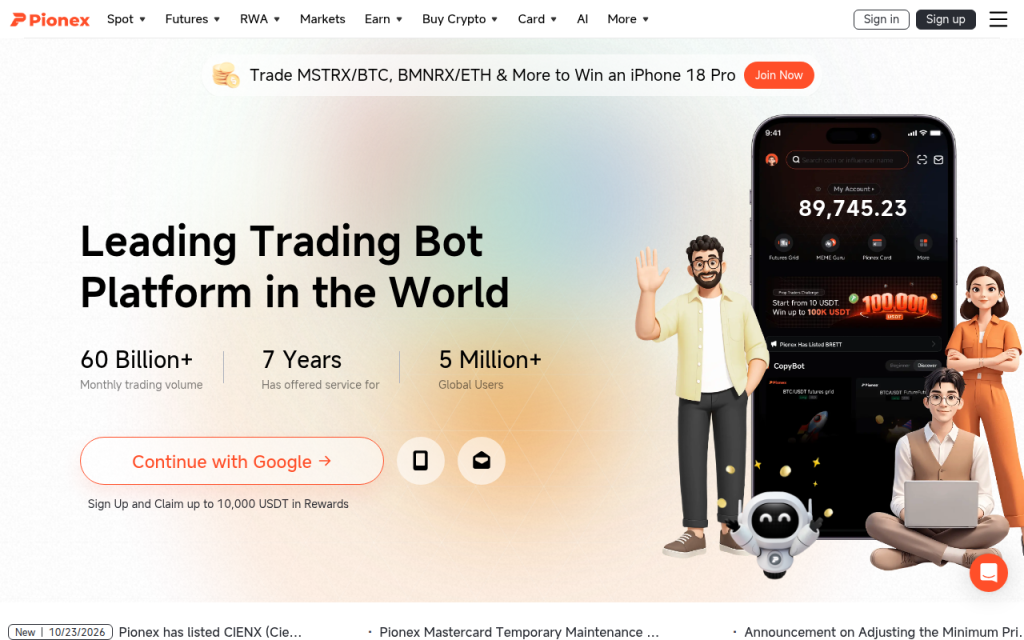
Screenshot of the company's public website, Pionex.
Published terms
- The bots run inside Pionex, so the homepage is the product rather than a third-party bot attached to another exchange
- Pionex’s articles, updated in August and September 2026, say there is no separate subscription for the built-in bots
- Those articles tell the reader to confirm the live fee schedule before starting
Limits
- The homepage capture shows promotional figures, including a reward up to 10,000 USDT and a phone illustration. Those are advertisements, not results measured here
- The fee table was not readable in the homepage capture. A trading fee still applies to filled orders
- Crypto trading can lose money. A bot does not remove that
Pionex is a crypto exchange that advertises built-in trading bots. This page is about what its public homepage shows and what Pionex’s own articles say about bot fees. The screenshot is https://www.pionex.com/en . The heading in the capture is “Leading Trading Bot Platform in the World.” Beside it are three marketing counts: “60 Billion+” monthly trading volume, “7 Years” in service, and “5 Million+” global users. A button says “Continue with Google,” and a line under it says “Sign Up and Claim up to 10,000 USDT in Rewards.” A phone illustration shows a sample balance and promotional art, including a “Win up to 100K USDT” graphic. Those figures are on Pionex’s advertisement. They are not balances, profits, or prizes measured for this review.
What the homepage does not show
The fee schedule is not in this capture. A reader cannot point at the screenshot and read a maker fee or a taker fee. The phone is an illustration. The number on its screen is part of that illustration. Treating the illustrated balance as someone’s result would misread a marketing image as an account statement. The reward line is an offer Pionex prints for sign-ups. This site did not sign up, did not receive USDT, and does not know the conditions attached to the “up to 10,000” line beyond the words on the page. “Up to” is Pionex’s cap on a promotion, not a payment that arrives for visiting the homepage.
The navigation shows Spot, Futures, and other product menus. Bots are the headline, not a separate company whose software connects to Pionex with an API key. That is the structural fact the homepage supports: the bots are presented as part of the exchange. It does not, by itself, say what a grid bot costs when an order fills.
What Pionex’s own articles add
Pionex’s articles about bot fees, including pages updated in August and September 2026, say the built-in bots do not have a separate subscription or activation fee. They also say that each filled order still pays the trading fee for that market, and that futures positions can owe or receive funding that is not the same thing as the trading fee. One of those articles describes a spot trading fee of 0.05% per fill as the rate readers were asking about, and it tells the reader to confirm the live schedule because rates change. The official fees URL did not return a readable table when this note was prepared, so the 0.05% figure is attributed to Pionex’s article, not to a row this reviewer transcribed from the fee page. The homepage capture does not confirm or contradict that percentage. It simply does not show it.
A completed grid cycle is a buy and a sell. If each fill carries a fee, the cycle carries two fees. That arithmetic is general. It becomes a dollar amount only after the fill size and the current rate are known. This page does not pick a sample trade and call it typical, because the homepage does not show a sample fill. It shows a promotion.
How this differs from a charting subscription
TradingView’s pricing page shows a software bill: $12.95 a month for Essential when billed annually, and higher rows above that, plus a free plan. That bill is for charts. It does not fill crypto orders. Pionex’s articles describe the opposite shape: no separate software subscription for the built-in bots, and a fee when an order fills. A person can pay TradingView every month and never trade, and can trade on Pionex with no bot subscription and still pay on every fill. Adding the two costs is legitimate only if both sentences stay intact. Calling Pionex “free” because there is no subscription drops the fill fee. Calling it a monthly plan like TradingView invents a subscription Pionex’s articles say it does not charge.
What Mintcanopy did not do
No Pionex account was opened. No bot was started. No order was placed. The Google sign-up button was not used. The promotional reward was not claimed. The volume and user counts in the hero were not audited. They are quoted as Pionex’s marketing lines, the way the reward line is quoted, and they are not independent measurements. Crypto prices move. A bot that buys and sells can lose money after fees. Nothing in the screenshot is a promise about that.
The image matches the subject of the page because it is the Pionex homepage, with the bot headline and the sign-up promotion visible. It does not match a sentence this review refuses to make: that the phone balance is a real account, or that the reward is cash in hand. The fee question has to be finished on Pionex’s fee schedule and in the order preview, which show the rate for the market the person actually intends to trade. The articles are the reason this page says “no separate subscription” at all. The homepage is the reason it will not pretend the cost was visible in the hero.
A practical check before anyone starts a bot on the exchange in this screenshot: open the fee schedule, note the rate for the exact market, and compare that rate with the size of one expected fill. Then read the funding line if the market is a perpetual. The homepage’s reward copy does not change that sequence. The articles say the bot itself adds no subscription. They do not say the fills are free.
## A reader checking the image against the fee sentence
The featured image is the homepage, so the check is visual. The heading in the capture is the leadership line about trading bots. The reward line mentions up to 10,000 USDT. The phone is an illustration. None of those elements is a fee table, and the review does not describe them as one. The fee sentences cite Pionex’s articles: no separate subscription for built-in bots, a trading fee on each fill, and a 0.05% spot figure that stays attributed to the article because the fee schedule itself was not readable for this note. If the homepage later drops the reward line, the image should be recaptured. The article citation can remain until the articles change. The two sources are allowed to move on different days. The review has to say which sentence came from which source, which is what the current note tries to do. A single “Pionex costs this” line would erase that split, and the split is the substance of the page.