
Figures below are taken from the vendor's public page. This is not a recommendation to buy or sell a security. Disclosure
Schwab Intelligent Portfolios
A reader checking Schwab’s “no advisory fee” line against the cash disclosure
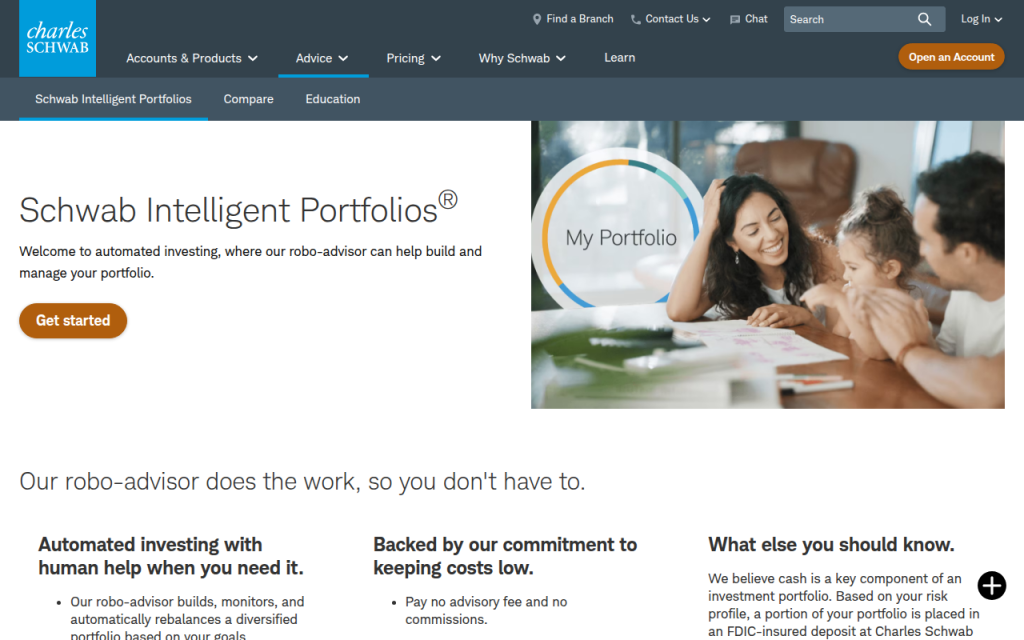
Screenshot of the company's public website, Schwab Intelligent Portfolios.
Published terms
- The public page states “Pay no advisory fee and no commissions”
- The same page says the program builds, monitors, and rebalances a diversified portfolio
- The cash allocation and the bank sweep are disclosed, including that Schwab earns on the cash
Limits
- ETF operating expenses still apply, including Schwab ETFs
- A cash allocation of 6% to 30% can weigh on results when other holdings outperform cash. Schwab discloses that effect
- Schwab Intelligent Portfolios Premium is a different offer, with a planning fee and a monthly fee. This page is about the standard program
Schwab Intelligent Portfolios is Charles Schwab’s automated investing program. This page records what Schwab’s own website and program brochure say about the cost, and the image is a screenshot of https://www.schwab.com/intelligent-portfolios, where the page states “Pay no advisory fee and no commissions.”
The captured page introduces the service as automated investing in which the robo-advisor builds and manages the portfolio. A lower section is headed “Our robo-advisor does the work, so you don't have to.” Under “Automated investing with human help when you need it,” the page says the robo-advisor builds, monitors, and automatically rebalances a diversified portfolio based on the client’s goals. Under “Backed by our commitment to keeping costs low,” the visible line is the one about the advisory fee and commissions. A third column begins “We believe cash is a key component of an investment portfolio” and says that, based on the risk profile, a portion of the portfolio is placed in an FDIC-insured deposit at Charles Schwab Bank. That is the sentence on the screen. The rest of the cash terms are in Schwab’s brochure, not in this first view.
What “no advisory fee” does and does not mean
Schwab’s public comparison of the program says clients do not pay an advisory fee and do not pay commissions. That is different from a claim that the client pays nothing at all. The ETFs inside the portfolio have operating expense ratios. Those ratios include Schwab ETFs. An expense ratio is taken inside the fund. It does not appear as a separate advisory invoice, and it is not cancelled by the “no advisory fee” line.
Schwab Intelligent Portfolios Premium is a different product. Premium has been offered with a one-time planning fee of $300 and a $30 monthly fee. This note is about the standard Intelligent Portfolios program, the one in the screenshot. If a page or a salesperson switches the conversation to Premium, the $300 and $30 figures belong to that other offer, and they should be read on Schwab’s Premium page rather than assumed from this one.
The brochure describes the cash allocation in more detail than the homepage hero. It says the cash allocation will generally range from 6% to 30% of account value. The cash is swept to deposit accounts at Charles Schwab Bank, and those deposits are eligible for FDIC insurance up to the applicable limit. Schwab earns revenue on that cash. The brochure also describes the conflict: when the other investments outperform cash, the cash allocation has a negative effect on performance relative to a portfolio that did not hold that cash. The homepage’s phrase “keeping costs low” sits next to that disclosure. Both are part of the published description.
A reader who wants a single dollar figure for “the fee” will not find an advisory-fee percentage on this program, because the published advisory fee is zero. The costs that remain are the fund expense ratios and the economic effect of the cash allocation. Those are not the same unit. An expense ratio is a percent of the fund’s assets. The cash allocation is a slice of the account that earns a bank-deposit yield while Schwab earns a spread or other revenue on the deposits. Comparing either of them to another firm’s 0.25% advisory fee requires saying which unit is which.
A numeric check, labeled as arithmetic
Take an $80,000 account only as a calculator example, not as a Schwab projection and not as a result from the family photograph on the page. At an advisory fee of zero, the advisory charge on that balance is $0. That is the figure that matches the sentence in the screenshot. It is not a forecast of the account’s value next year.
The cash slice is a different calculation. If the allocation were 6% of $80,000, the cash would be $4,800. If it were 30%, the cash would be $24,000. The brochure says the allocation generally falls somewhere in that range and depends on the risk profile. This page does not know a particular client’s profile, so it does not pick a point inside the range and call it typical. The point of the range is that a meaningful part of the account can sit in bank deposits even though the advisory fee is zero.
Fund expense ratios are extra and vary by ETF. This page does not multiply an assumed expense ratio through the $80,000, because the screenshot and the sentences above do not state one blended ratio. A person who wants that number has to read the fact sheet for the funds the program actually holds.
What this page did not do
No Schwab account was opened. The questionnaire that produces the allocation was not filled in. The rebalancing trades were not watched. The FDIC line was read as Schwab wrote it; the insurance limit and the bank’s current rate were not re-checked against a deposit statement. Nothing on this page is a prediction of return. The photograph of people at a table is Schwab’s marketing image inside the screenshot. It is not evidence about performance.
The same restraint applies to the other managed accounts discussed elsewhere on this site. Fidelity Go’s March 30, 2026 brochure uses a $0 advisory fee under $25,000 and 0.35% a year on the whole balance once the account is at $25,000 or more. Vanguard Digital Advisor publishes a gross advisory fee of 0.20% for an all-index option and 0.25% for an active/index mix, then a net fee after a credit for certain Vanguard revenue, described as approximately 0.15% for a typical all-index portfolio. Those are advisory fees. Schwab’s standard program publishes none. Putting the three in one sentence is fair only if the cash allocation and the fund expenses stay in the sentence too.
How to use the screenshot
The image at the top of this review is the public page, captured in a browser, not a drawing of a dashboard and not a chart with an invented axis. The fee sentence a reader should be able to find in it is “Pay no advisory fee and no commissions.” The cash sentence begins “We believe cash is a key component of an investment portfolio” and continues into the FDIC-insured deposit at Charles Schwab Bank. If Schwab changes the page, the brochure remains the source for the 6% to 30% range. Read the current page before opening an account, because a marketing line can be edited without a new brochure date appearing in the hero.
Who the published description fits
Schwab describes a person who wants the firm to build, monitor, and rebalance a diversified portfolio, with human help available, and who accepts a cash allocation as part of that portfolio. The page does not describe a stock-picking account. A person who wants every dollar in ETFs, with no bank-deposit sleeve, is looking at a different product than the one this disclosure describes. A person who wants a written financial plan for a separate $300 charge is looking at Premium, not at the program in this screenshot.
Mintcanopy does not score the program. A score would imply a test that was not run. The page’s job is narrower: show the public site, quote the fee line that is actually on it, and put the brochure’s cash range next to that line so the zero advisory fee is not mistaken for a zero-cost portfolio.