Every review on Mintcanopy is one product, one fee, and a screen of the place you will look before you pay. Start with the fee row, then the export, then the paragraph that says who should skip it.
How to read one of these
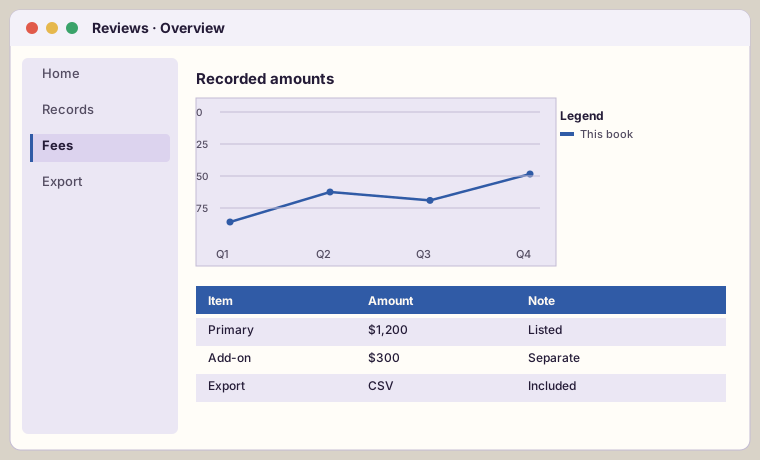
Start with the price under the title. Then look at the drawing: it is a window with navigation and either a chart or a table from the review, not a decoration. Then read the first paragraph, which says the score and the job. Then read who should skip it before you read the pros. Mintcanopy puts the skip on the page because a list of pros is how a review becomes an ad.
The scores in this catalog
Harbor Path is 4.6 at 0.25 percent for a taxable account. Kindling Invest is 4.2 at 0.35 percent for a first IRA. Folio Lens is 4.5 at $49 a month for filings with source lines. Quarry Research is 4.1 at $89 a month for coverage gaps. Signal Orchard is 4.3 at $39 for alerts that name a price. Chartloom is 4.4 at $29 for a replayable chart. Gridwell is 3.9 at $24 plus exchange fees, marked down because the sticker hides the exchange. Driftlane is 4.0 at 0.08 percent of the fill with the exchange fee on the row. Closeweek is 4.5 at $79 for a checklist with owners. Ledger Mint is 4.2 at $59 for variance notes. Those sentences are the index. The reviews are the evidence.
A score is not a queue
Do not buy the highest number if the skip paragraph is you. A 4.6 for Harbor Path is the wrong number to chase if you are holding one employer stock. The index is alphabetical by the catalog, not a race. If a review is missing a screen, it is not finished, and it should not be in this list.
The index, with the units attached
Harbor Path 4.6, 0.25 percent, taxable lots. Kindling 4.2, 0.35 percent, first IRA. Folio Lens 4.5, $49, source lines. Quarry 4.1, $89, coverage gaps. Signal Orchard 4.3, $39, alerts with a price. Chartloom 4.4, $29, a replayable chart. Gridwell 3.9, $24 plus the exchange. Driftlane 4.0, 0.08 percent of the fill plus the exchange on the row. Closeweek 4.5, $79, owners on open tasks. Ledger Mint 4.2, $59, variance notes. The drawing on each review is the screen, with navigation and a table or chart.
Do not chase the highest number into the wrong job. A missing screen means the review is not in this list.
How the catalog was opened, in order
We did not score the ten products in one sitting, and the index should not be read as one sitting. Harbor Path's afternoon was the fee screen: 0.25 percent on taxable $80,000, rollover IRA $42,500, and trust $15,000, plus a lot CSV. Kindling's afternoon was the sweep: Roth $18,400, cash $6,200, brokerage $9,100, all at 0.35 percent, and the cash was not a yield. Folio Lens was North Mills Item 1A and a verb, "material," that was stronger than the filing's "may." Quarry was the fourteen excluded names and a blank score for GLS. Signal Orchard was a week with a skip. Chartloom was twenty NML sessions and an average of 44.80 that matched a spreadsheet. Gridwell was a key with Withdraw refused and a $24 sticker that is not the month. Driftlane was three orders where the fixed exchange charge beat the percent on the small one. Closeweek was day 4 with Ortiz still on cutoff. Ledger Mint was three notes a controller can ask a follow-up of. Mintcanopy keeps that order in the index so a high score cannot be lifted out of its afternoon.
The drawing on each review is the screen from that afternoon: window buttons, a left navigation, a chart or a table. If you are skimming, skim the drawing and the skip paragraph. The pros are the last thing to read. A list of pros is how this index would become an advertisement, and the scores would stop meaning the checks.
Scores are not a queue
Harbor Path at 4.6 is the wrong number to chase if you hold one employer stock with a blackout calendar. Gridwell at 3.9 can still be the right bot if you want a subscription and you have already added the exchange fee. Folio Lens at 4.5 does not answer Quarry's question. The index is the catalog order, not a race. A missing screen means the review is not in this list. A commission, if a link pays one, is disclosed on the review and is not in the average.
What the index leaves in the reviews
The index can say Gridwell is 3.9 and Driftlane is 4.0, and it still cannot show you the $400 solana row where the exchange charge of $0.90 beat the 0.08 percent. That row lives on the Driftlane review, in the table under the chart. The index can say Closeweek is 4.5 and it still cannot show you that the accrual was marked asked rather than done. That distinction lives on the close guide and on the product page. Mintcanopy keeps the index short on purpose and the reviews long on purpose. If a sentence in the index is the only place a number appears, the index has failed and the number has to move into the review where the screen is.
A reader who prints the index and takes it to a meeting has the units and the scores and does not have the skips. Print the skip with it or do not print it. Harbor Path's skip is the employer stock. Kindling's skip is the old taxable lot file. Quarry's skip is a desk that only follows ten names and does not need a coverage file at $89. The meeting that uses only the score will buy the wrong product, which is the failure this index is built to prevent.