Guides
A guide on Mintcanopy is one decision: what a fee costs over thirty years, which tax lot was sold, which API permission to refuse. If a guide tries to explain a whole industry, it is hiding the decision.
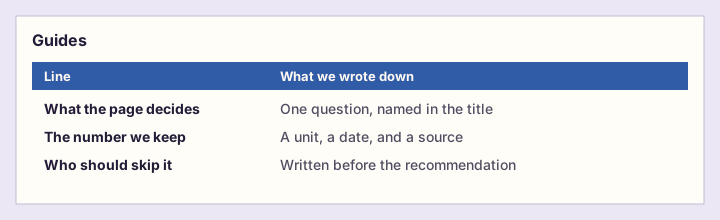
One decision each
The fee guide multiplies 0.25 percent across thirty years. The taxable-account guide sells one hundred shares out of two lots with different basis. The filing guide follows North Mills from Item 1A to Note 7. The screen guide starts from four thousand names and asks which column was blank. The alert guide keeps a skip. The backtest guide names the year the rule lost. The API guide refuses Withdraw. The exchange guide adds the exchange fee to the $24. The close guide will not mark the bank done. The variance guide will not accept the word timing. The demo guide is the email you send before the call. The affiliate guide follows a $49 click. That is the whole index of Mintcanopy's guides.
Read the guide before the review
The review assumes you know what the unit means. If 0.25 percent still sounds like a quarter of a percent of your first deposit, read the fee guide before Harbor Path. If you have not thought about which lot is sold, read the tax guide before you transfer anything. The guides are the textbook. The reviews are the lab.
Which guide matches the decision
Percent over thirty years, the fee guide. Which lot was sold, the tax guide. A verb stronger than the filing, the filing guide. A blank column in a screen, the screen guide. A skip that stays visible, the alert guide. A losing year that stays on the page, the backtest guide. Withdraw refused, the API guide. The exchange invoice, the exchange guide. An owner on the bank rec, the close guide. A reason that is not the word timing, the variance guide. The email before the demo, the demo guide. A tagged $49 click, the affiliate guide.
Read the guide before the review if you do not yet know the unit.
A treasurer, a trader, and a controller
A treasurer who has just been shown 0.25 percent should open the fee guide and the tax-lot guide before any review. The fee guide is the thirty-year bill on $80,000 with $500 a month. The tax guide is the hundred shares at a $22 basis versus the hundred at $47. Those are not the same afternoon. A trader who wants a bell should open the alert guide and the backtest guide: a week that includes a skip, and a 2022 stretch where a twenty-day cross lost. A controller should open the close guide and the variance guide: owners on day 4, and a $6,400 contractor gap that is not the word timing. Mintcanopy split the guides this way so the index is a desk assignment, not a magazine.
The demo guide is the email before any of those products are shown. The affiliate guide is how a $49 click can pay the desk without moving a score. Read those two if you are about to forward a page to a colleague who was not on the call. The colleague needs the unit and the tag, not your summary of the salesperson.
What does not get a guide
A guide that explains "AI in finance" does not get written. The phrase hides the bill. If a draft cannot be reduced to one decision and one set of figures, it stays a draft. The reviews assume you have read the matching guide. Harbor Path assumes the fee guide. Folio Lens assumes the filing guide. Gridwell assumes the API guide. Starting at the review is allowed. Starting at the review and skipping the unit is how 0.25 percent gets mistaken for a quarter of the first deposit.
Where the figures live
The fee guide holds the thirty-year walk and the one-percent comparison. The tax guide holds the third lot at $30 and the warning that a wash sale is outside the example. The filing guide holds Note 7's covenant and Harbor Glass at $214 million against $206 million. The screen guide holds 4,000, then 40, then 110 when the earnings filter is lifted. The alert guide holds Friday with no rule armed, so the journal stays quiet on purpose. The backtest guide holds 3 February, 14 March, and 2 May. The API guide holds the key name gridwell-paper-march and the $500 cap. The exchange guide holds months A, B, and C. The close guide holds the word asked. The variance guide holds the follow-up each sentence earns. The demo guide holds the email subject. The affiliate guide holds the click. Mintcanopy will not move those figures up into this index and call the index a guide. The index is the assignment. The guide is the work.
If you are new, do not read all twelve in a night. Read the one that matches the bill on your desk this week. A treasurer does not need the bot key tonight. A person creating a key does not need the variance note tonight. The index exists so you can refuse the other eleven without feeling you missed a hidden recommendation.
Twelve decisions, not a syllabus
A reader who tries to finish every guide before buying anything will not buy this quarter, and that is sometimes correct. It is not what the index is for. The index assigns one guide to the bill on the desk. A 0.25 percent quote gets the fee guide, and the fee guide's year-30 fee near $2,268 is not copied onto this page as if the index had done the multiplication. A transfer of shares gets the tax guide, including the third lot at a $30 basis and the warning that the oldest-lot default realizes the $1,900 gain. A summary of a 10-K gets the filing guide. A screen of forty names gets the screen guide and the counts 4,000, 110, and 300. An alert gets the week that includes a skip. A backtest gets the three dates in 2022. A key gets Withdraw. A bot invoice gets months A, B, and C. A close gets the word asked. A variance gets the empty cell. A demo gets the email. A tagged link gets the $49 path. Mintcanopy leaves those figures in the guides. This page is the list of doors.