Shop
The shop view is the same catalog as the reviews index, shown through the catalog software’s own archive. Mintcanopy does not operate a store. The entries are notes about Fidelity Go, Vanguard Digital Advisor, Schwab Intelligent Portfolios, Koyfin, TradingView’s plan prices, Pionex, and QuickBooks Online. A price printed next to an entry in this view is a label from the review, or a placeholder the software attached. It is not a price you pay to this publication, and it is not a newer number than the one in the review.

Prefer the reviews index if the two views ever disagree. The review has the source URL, the description of the screenshot, and the limits of what was captured. This archive is a list. Lists are useful for finding a name. They are a bad place to read a fee schedule.
The seven entries and the bills they describe
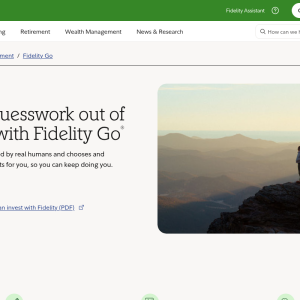
Fidelity Go is a managed account. The March 30, 2026 brochure charges no advisory fee under $25,000 of average daily assets and 0.35% a year on the whole balance from $25,000 up. The product page says there is no trading, transaction, or rebalancing fee. The review’s image is the marketing hero. If a shop tile shows a dollar price that is not $0 and not 0.35%, ignore the tile and read the review.
Vanguard Digital Advisor is a managed account with a $100 minimum per enrolled brokerage account, gross advisory fees of 0.20% or 0.25%, and an approximate net fee near 0.15% after a credit. Expense ratios are extra. The image is the Digital Advisor hero. Personal Advisor is not this entry.
Schwab Intelligent Portfolios is the program whose captured page says “Pay no advisory fee and no commissions.” The brochure’s cash allocation is generally 6% to 30%, swept to a bank deposit. ETF expenses still apply. Premium is a different product. A shop tile that attaches a dollar amount to the standard program is not quoting the advisory fee, because that fee is zero. Read the review before you conclude the program is free. Zero advisory fee is not the same claim.
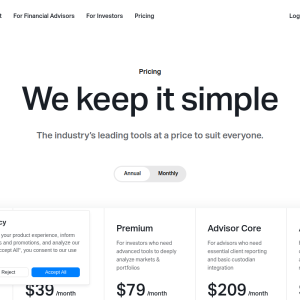
Koyfin is the research terminal. The monthly capture shows $0, $39, $79, and $209. Premium and Advisor Core are the readable names. Advisor Pro’s price is not in the review. A single price on a shop tile cannot represent four columns. Open the review and then the pricing page.
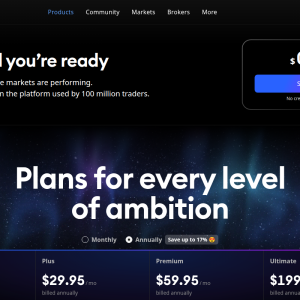
TradingView’s entry is the plan grid, annual billing. $0, $12.95, $29.95, $59.95, and $199.95 a month, billed annually. A tile that shows only one of those numbers has dropped the rest. The monthly toggle is a different grid and was not copied.
Pionex’s entry is the exchange homepage and the articles about bot fees. The homepage is an advertisement, including a reward line of up to 10,000 USDT and a phone illustration. The articles say built-in bots have no separate subscription and that fills still pay a trading fee. A shop price of zero would repeat only half of that sentence. Read both halves in the review.
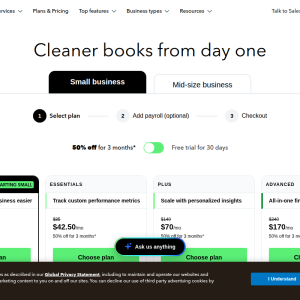
QuickBooks Online’s entry is the pricing capture with the three-month discount on. The pairs are $38 and $19, $85 and $42.50, $140 and $70, $340 and $170. A tile that shows only $19 has kept the promotional number and dropped the list price. The review’s first-year sketches, $399, $892.50, $1,470, and $3,570 before payroll, exist so the lower number is not mistaken for the renewal.
Categories in this archive
The catalog groups match the hubs. Robo-advisors hold the three managed accounts. Research holds Koyfin. Charting holds the TradingView note. Crypto bots holds Pionex. Accounting holds QuickBooks Online. A leftover default category with no review is not a sixth product line. The five hubs in the footer are the map. If this archive shows an empty group, skip it.
Featured images in the archive should be the same screenshots as on the reviews: the vendor’s public page, not a drawing and not a stock photo. A stock photo means you are looking at a guide or an ordinary page, not at a product screen. The caption on a stock photo says it is from Unsplash and is not a product screen. The review image does not carry that caption, because it is the vendor’s page.
Buying is not what this archive is for
Adding an entry to the cart from this archive does not subscribe you to the product. The cart page and the checkout page say that at length. The link that leaves the publication for a vendor is the button on the review. Use the reviews. Use this shop view only as a second door onto the same list, and if the door shows a worse label, do not trust the label. Trust the review that names the page the number came from.
## Featured placement is not a shelf you can buy
The homepage shows featured reviews. In this catalog the featured flag is on the seven notes that were actually written, so the shop and the homepage are the same set. There is no eighth product waiting for a placement fee. There is no bidding for the first tile. If a future commercial link is added, the affiliate page requires the review to say so, and it forbids the payment from changing a copied figure or from creating a score. The shop archive does not become a store on that day. It remains a list of notes.
Sort orders, if the software offers them, are software defaults. “Popularity” in a catalog that has no sales is not a measure of which robo-advisor is appropriate. “Price” as a sort is actively misleading, because the advisory fee is a percent, the charting plan is a set of annual equivalents, and the bot’s cost is per fill. A sort that needs one number will invent a ranking the editorial policy rejects. Ignore the sort. Open the category you came for, then the review, then the vendor page named in the review.
Showing all 7 results